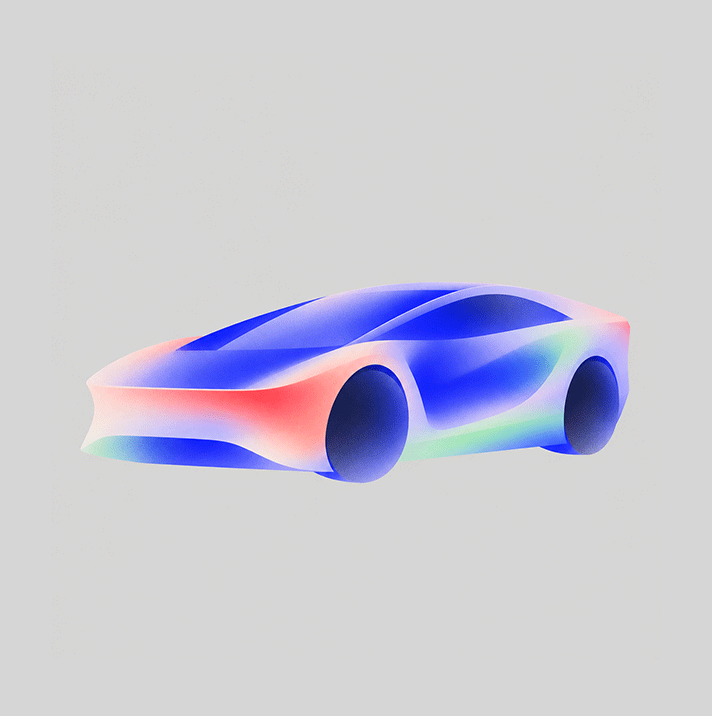
There are product launches, and then there are product launches that carry a much bigger brand story.
CEER’s unveiling of the EXOBOT Sedan and SUV is both. Saudi Arabia’s automotive ambitions have gone from zero to sixty by launching its first homegrown automotive brand – and, with dramatic timing, the cars are electric.
The irony is neat. The nation and region that accumulated extraordinary wealth by extracting hydrocarbons is now presenting a machine designed to make the internal-combustion engine obsolete.
It’s a compelling story. But stories are not necessarily the same thing as brands. A brand has to survive contact with reality. And that’s what makes CEER so interesting.
The name itself means “drive forward” in Arabic. A tidy piece of verbal positioning: short, energetic, optimistic and directional. It says movement without saying motors; modernity without sounding industrial. It avoids the feel of a government-backed initiative and, at least in English, sounds like something that might already exist in a showroom in California or Copenhagen.
CEER is backed by Saudi Arabia’s Public Investment Fund and Foxconn, with BMW technology. This gives the brand international technical credibility, but it creates a delightful paradox: Saudi Arabia’s first major homegrown automotive proposition is also a multinational collaboration.
That is not a weakness. In fact, it may be the only sensible way to launch a modern car company. Automotive history is full of badges concealing complex webs of platforms, suppliers, licences and shared components – the supposedly pure national automobile has almost always been a united nations conceit.
That said, CEER is not simply saying, “Here’s a good car made with help from everyone.” It is a Saudi car, born in Saudi Arabia, representing a changing Saudi Arabia.
It’s nation branding with wheels and a battery pack.
The company is not merely trying to sell a sedan and an SUV, it is part of a broader effort to change the mental picture of Saudi Arabia: from energy exporter to technology producer, from customer to creator, from a place where global brands sell cars to a place that designs and manufactures them.
This is a substantial repositioning exercise. And unlike most repositioning exercises, it comes with a sovereign wealth fund, a national economic strategy and a factory.
Every new economy is financed, at least in part, by the old one. The question is whether the money creates lasting capability or merely an expensive piece of theatre.
That distinction matters because CEER is entering a brutally unforgiving category. Cars are not like smartphones, where a glossy launch and a good interface can buy a company time. A car has to start every morning, survive heat, dust and indifferent traffic, and be repairable by someone who is not the chief executive.
No amount of futuristic naming can substitute for contemporary reliability. No “born in Saudi Arabia” brand story can excuse a disappointing ownership experience. And while “designed for tomorrow” sounds excellent in a campaign, consumers may reasonably ask whether the car is also designed for today, particularly today’s potholes, service centres and electricity grids.
This is where CEER’s brand will be built. Not at the reveal, but after it: in the quality of the doors, the speed of the software updates, the availability of parts and the experience of someone whose car will not charge on a Thursday evening.
The EXOBOT’s spectacular design and performance claims are useful attention-getters. They make the car feel like an arrival rather than an announcement. But the more important brand task is to make “Saudi” mean something specific and desirable in automotive terms.
Does it mean heat-tested engineering? Elegant hospitality translated into customer service? A distinctive regional design language? Serious manufacturing discipline? Or simply that the car was assembled within the Kingdom?
A successful brand cannot leave that meaning vague. “Saudi” could become a source of preference, not just provenance.
That is the opportunity. CEER can make the Kingdom’s transformation tangible. Vision 2030 can be experienced not only as a policy document or a skyline, but as the object sitting in someone’s driveway. But therein also lies the risk. The more CEER is asked to carry the ambitions of a nation, the less room it has for ordinary mistakes. A conventional startup can have a bad first model. A brand positioned as a national champion has to explain what the bad first model says about the nation.
CEER, then, is not simply launching an electric car. It is launching a new story about Saudi Arabia and inviting people to take that story for a test drive.
For decades, Saudi Arabia’s global reputation has been closely associated with energy, scale and ambition. CEER is part of an attempt to add invention, industry and forward motion to that perception. That is a formidable repositioning.
And, in a final twist of brand irony, the most important thing about Saudi Arabia’s first car may be that it is asking the world to pay attention to what the country can create, not just what comes out of the ground.